


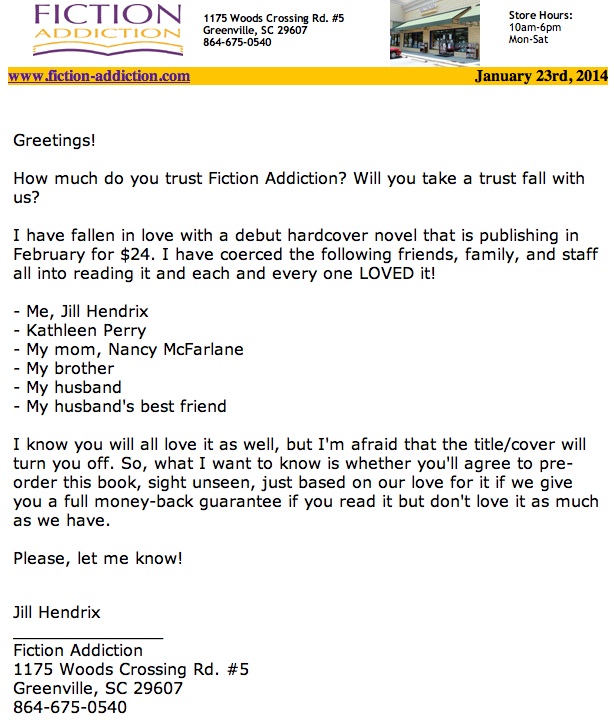
Fiction Addiction – a great independent bookstore in Greenville, South Carolina – recently sent this email to their subscribers:
Apart from being an idea so awesome that I jealous-hate Jill Hendrix the weensiest bit – why didn’t I think of it first? – it got me thinking about those titles I need to handsell with a disclaimer. Just in case the customer has brain damage or a vision problem and actually likes the cover, I don’t bash on it right off. But once I see that I-smell-sour-milk nose scrunch, I implore them to ignore the cover and focus on the guts.
Books are all about guts. I’ve come to appreciate the collectors in this business; they are discerning, addicted, and they keep the doors open. But I’ve yet to understand them. To me the point of a book is to read the story, not to find the perfect, pristine dustjacket. Isn’t a book that’s well-worn a book that has been well-loved?
Even customers who aren’t first edition fanatics fall into the book-as-object trap.
Customer (holding a mass market): This cover is bent, can I get a discount?
Me: Um… sure.
Customer: Oh, I love this book so much. I have the cutest lamp and beside table in my living room. The cover will match perfectly.
Me: Score.
Customer: I’m hoping you can find me books in black and white.
Me: You men like, photography? Or graphic design? Interior design? Fashion?
Customer: No, not that. The covers. They have to be regular-sized books, but they need to be either black or white.
Me: Yes, let me show you the colorless hardcover section.
Budding interior designers and compulsives aside, it’s the first customer I’m worried about. This isn’t a defective t-shirt or a tepid appetizer or a leaky milk carton, this is a book. Rip the cover clean off and the words will still work. The words, the story, the guts, that’s the whole point of your purchase – to find the story that will wrap you up and swing you along.
But I digress. Jill Hendrix at Fiction Addiction understands the bookseller’s dilemma of trying to recommend a book with a sub-par jacket. Every book doesn’t have Chip Kidd, Thomas Allen, or Gabriele Wilson doing its cover design, and the text-only route is Salinger’s signature, which sometimes leaves us with terrible covers on great books.
I read Aryn Kyle’s The God of Animals as an Advanced Readers Copy. A gorgeous coming-of-age novel, Cormac McCarthy meets Judy Blume (in the greatest way), and a book I predicted would be the next Kite Runner. That didn’t happen, but critics loved it and readers who have leaped into The God of Animals at my urging have trusted my recommendations ever after.
When the finished book arrived months later, I was shocked to see the story I so loved repackaged as a starry reboot of Black Beauty.

That cover looks like Simon & Schuster decided to make a Unicorn Planet series for teens, and it made hand-selling my favorite book of the year a challenge. The paperback was an improvement but it still kind of looked like a sequel to The Curious Incident of the Dog in the Night-Time.
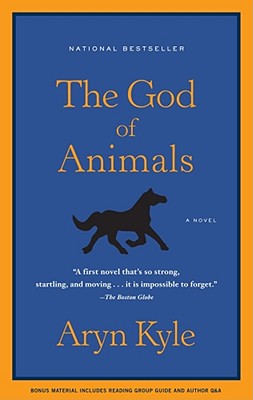
The marketing department went round and round and kept landing on the fact that there are horses in this book. Why bother trying to suggest a book’s emotional truth when you can just slap an equine on the cover? “You like horse? This is you!” Well I have no strong feelings about horses one way or the other, and this is still one of my favorites.
I know, I know – the story is more important than the cover when selling a book. But it shouldn’t be so terrible that it hinders sales, either.
Take This Book Will Save Your Life by A.M. Homes, a book so solid she made me a fan for life in just one reading. The hardcover is really cool. The paperback is this, the “before” picture of a tattoo cover-up.
This looks like everything that’s bad about self-publishing, yet it came from Penguin, a house with a rich tradition of classic covers since 1935. I guess they can’t all be home runs.
Booksellers love unique and offbeat but I’m sure books like Lydia Millet’s Oh Pure and Radiant Heart are a marketing department’s worst nightmare. Despite being dead, Robert Oppenheimer, Leo Szilard, and Enrico Fermi reappear in New Mexico sixty years after their first successful test of the atomic bomb they created. They are taken in by a shy librarian, but once their reemergence becomes public a media circus ensues. Oh Pure and Radiant Heart is beautifully-written, fascinating, and fun, but how the hell do you capture it in an image?
The hardcover from Soft Skull Press went for the obvious:

Maybe not great. It looks like it would be a post-apocalyptic story, which is way off the mark, but to me it never shot itself in the foot they way the hardcover of The God of Animals and the paperback of This Book Will Save Your Life did.
The paperback from Houghton Mifflin Harcourt doesn’t shoot itself in the foot, it takes a plaster cast of the foot, fills the cast with chocolate to make a replica of the foot, puts the choc-o-foot on display outside of the New York Public Library in winter, and films homeless people trying to eat it.
It’s weird, is what I’m saying.

HMH keeps the mushroom cloud – blergh – and adds a bunch of Male Poppins flying off a pier into it. If the trenchcoated, umbrella-sporting fellas represent the three men responsible for creating the atomic bomb, then why are there four of them? If the line is endless, then what the hell do they represent? Does the nuclear apocalypse make Gene Kelly-s of us all?
What’s really upsetting is that Vintage UK got this one right.

The US never saw this one. I don’t know whether to feel insulted (We can’t use this; Americans will never recognize Robert J. Oppenheimer) or flattered (We can’t use this; Americans will never stand for the omission of Leo Szilard and Enrico Fermi).
To me, this cover is perfect. It gives you a glimpse of the guts without trying to encompass everything and without – sin of sins – getting in the book’s way. Oppenheimer’s most famous portrait, rendered in Ralph Steadman-esque lines. It tells you “Oppenheimer, but not.” It calls to mind over-the-top journalism that’s more about spectacle than substance. Hopefully, it intrigues you enough to pick up the book without some bookseller around to tell you it’s a good idea.
Which is what a decent cover should do.

 Aaron John Curtis
What do you think?