

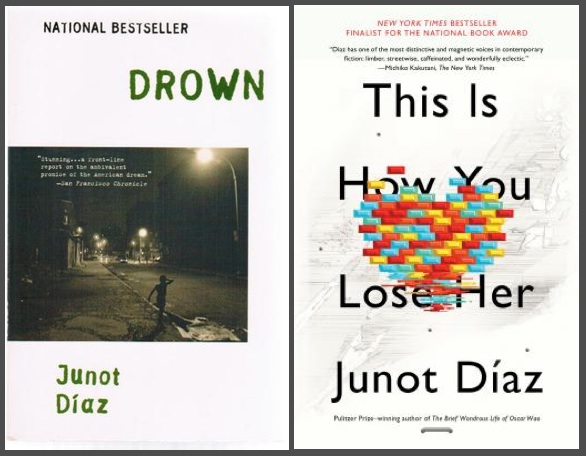
If you’ve been inside a bookstore the last few years then you already know you should read Junot Diaz. He’s been everywhere since Brief Wondrous Life of Oscar Wao netted him a Pulitzer and a National Book Critics Circle Award (if you’re reading this from outside the book business and haven’t heard of the second award, then you’re forgiven; just know that prestige-wise, if the National Book Award is like an Oscar then the National Book Critics Circle Award is like a Golden Globe).
He didn’t drop from the sky like a lit bomb, though. Before critics noticed him, his short story collection Drown was delighting readers for just over a decade.
I can’t exactly recall what I loved about Drown all these years later. I remember sitting in an airport after I turned the final page, staring into space, content to wait another hour for my layover – to do nothing but sit and wait. That activity didn’t feel like it normally does, which is a mind-crawling feeling of “nothing to do.” It felt like I needed a moment before I could resume my normal life. Make of that what you will.
Here are two quotes from This is How You Lose Her that struck me:
She wasn’t at her lowest then but she was aiming there.
And:
These were not the sort of questions that had answers.
There’s so much contained in those sentences that they’re almost poetry, yet they’re simple and readable. Open to any page of This is How You Lose Her and whatever is happening will suck you in. It has plenty of characters on their way to becoming something else, and questions too complicated, painful, or absurd for answers.
Stuff I learned:
Frank Frazetta – artist best known for his covers of “Conan the Barbarian” books.
Georgina Duluc – Miss Dominican Republic 1997. Here’s a link for… citation purposes.
Pelagic – of or relating to open oceans or seas (as in “pelagic sadness” – nice)


 Aaron John Curtis
What do you think?